
If you’re in the market for a new air conditioning system or looking to update your existing system, then you may be stuck between a ducted and a split system air conditioning without knowing which one is right for you.
In this guide, we go through the core differences that separate ducted and split system air conditioning, how to choose what’s going to be right for you, and the factors that you need to consider before you buy your next air conditioning system for your home or office.
Ducted vs Split System: What's the Difference?
A ducted air conditioning system is a whole home or building heating and cooling solution that is controlled from one or multiple different central controls, and comes through a network of ducts into vents in multiple different rooms. A split system air conditioner, on the other hand, is a single wall-mounted unit that is intended to cool one room or one space in the home or office.
Ducted air-conditioning utilises an external outdoor condenser that’s typically mounted on a roof and connected to an indoor control unit that’s usually hidden in a ceiling space. The control unit directs the warm or cold air to different rooms through ducting with vents at the end.
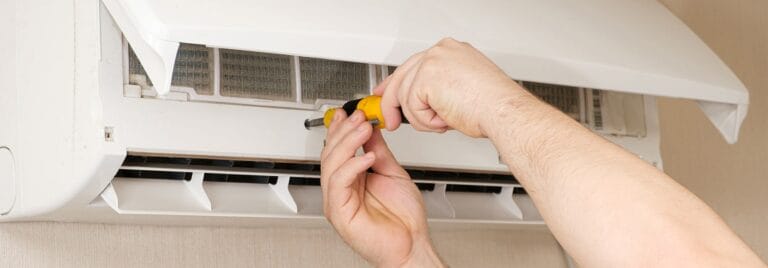
A split system air conditioner pairs a compressor that’s typically mounted outside on a wall or balcony, along with a wall-mounted indoor unit that’s connected via pipes. The interior unit that blows the cool or warm air will only operate in a single room or location.
Pros and Cons of Ducted Air Conditioning
There are advantages and disadvantages to both ducted air-conditioning and split systems. From size and cost, to functionality and installation time, there are key differences that will impact what’s best for you.
Pros of Ducted Air Conditioning
Efficient multi-room cooling and heating: Ducted air conditioning is an energy efficient way to cool and heat several rooms in a home, particularly with modern zoning controls that let you turn off unused spaces.
Ideal for large homes: This makes it ideal in large properties that need temperature control in multiple areas.
Visually discreet: Plus it’s also visually discreet, with only small ceiling grilles inside the living spaces and bedrooms.
Easy to install in new builds: Ducted is particularly ideal for new builds where installation is easy.
Cons of Ducted Air Conditioning
Higher upfront cost: The primary negative of ducted air conditioning relative to split systems is the higher initial investment, which typically ranges from $8,000 to $22,000+ depending on the property size. That said, if you need multiple split systems to service your home, the costs add up.
Longer, more involved installation: Another downside of ducted is that installation takes a lot longer and can require alterations to already-built homes.

Pros and Cons of Split System Air Conditioning
Split system air conditioning has come a long way over the years. There have been improvements in efficiency, style, functionality and range. However, there are a few downsides to it that are worth considering.
Pros of Split System Air Conditioning
Great for smaller spaces: For small homes, apartment living or cooling a single room, split system air conditioning works really well.
Quick and unobtrusive installation: It’s very easy to install, usually only needing a day’s work, and isn’t overly intrusive as the external units are relatively small and quiet, and the internal part can sit out of the way, high on a wall.
Lower cost, energy efficient: Other benefits of split systems are the low cost and energy efficiency, as you can focus on cooling or heating the specific room you’re using.
Cons of Split System Air Conditioning
Limited coverage: Because each unit is designed to cool or heat only a single room or space, the coverage is limited and you may need multiple units for your home.
Costs add up with multiple units: With multiple units comes added costs and reduced energy efficiency compared to ducted air conditioning.
Wall clutter: Also, despite improvements in design, some people feel the units create wall clutter which can interrupt interior aesthetics.
Finding space for the outdoor unit: Another issue relating to clutter is finding a suitable spot for the outdoor compressor unit, particularly if you live in an apartment.

Ducted vs Split System Installation Costs
The installation costs of implementing a ducted or split air conditioning system vary greatly.
Split system unit prices: For a split system the units themselves range from the very cheap at around $500, to more costly options upwards of $2,500.
Split system installation costs: Some retailers will offer installation as part of the service, particularly for the higher end models, but if not, you’re looking at an additional $500+ for a tradesman to install the system.
Ducted installation in new builds: With a ducted air conditioning system, installation into a home during construction makes things a lot more cost effective and easy.
Average ducted system cost: For the average home, a ducted air con costs from $10,000 to $18,000 depending on the size of the property, complexity of the install and the system used.
What affects ducted pricing: The bigger the home and more zoning requirements, the larger the system required and higher the material and labour costs.
Ducted vs Split System Running Costs
The running costs of a split air conditioning system are much lower than a ducted system, mainly because they are typically smaller units and only operate in a single room. The exact outgoings depend heavily on the kilowatt (kW) capacity of the unit, with the usage costs of a split system ranging from 20 cents to 80 cents per hour. If you have a reverse cycle system, it’s marginally cheaper for winter heating than it is for summer cooling.
A ducted air conditioning system costs significantly more to operate, from 80 cents to $3.50 per hour, depending on how powerful the system is and how many rooms you are operating it in. However, they are generally much quicker at heating and cooling spaces, therefore need to run for a lot less time than a split system.
To prevent either systems breaking down or running inefficiently, it’s important to get regular professional maintenance. Amongst other things, the technician will be able to clean or replace filters, check for blocked airflow and ensure there are no refrigerant leaks.
Ducted or Split System: Which Suits Your Home?
Split system air conditioning is ideal for small homes, apartments or if you just need to control the temperature in a single room. They’re a great, low-cost alternative for those wanting seasonal comfort without the need to regulate their entire home.
Ducted air conditioning is ideal for larger homes, new builds and those after a whole-of-home alternative for temperature control. It’s visually discreet and energy efficient for multi-room heating and cooling.