


How often you service your aircon isn’t a one-size-fits-all answer.
In most parts of the world, servicing your air conditioner once a year is considered the gold standard. In Singapore, however, where air conditioners rarely get more than a full day of respite, the answer is very different.
Aircon units in Singapore run year-round here, battling 84% average humidity and overnight lows that rarely dip below 23°C. What’s more, conditions inside most homes sit permanently in the zone where mould starts colonising within 48 hours. Combine that with 6+ hours of daily use and it’s easy to see why Singapore operates on a completely different (higher) frequency than just about any other climate in the world for air conditioner servicing.
This article will explain recommended aircon service frequencies in Singapore, the factors that influence service intervals, and why keeping your air con servicing up to date is so important.
Table of Contents
Recommended Aircon Service Intervals in Singapore
Recommended AC Intervals By Usage
The recommended aircon servicing interval in Singapore depends on how much the unit is actually used. As an example, an AC unit that is only used for 1–2 hours per day (such as in a spare room) may only need servicing every 6–9 months. Conversely, an AC unit that is being used constantly (think 6–10 hours daily) may need to be serviced every three months.
Below is a complete breakdown of four different examples of AC service frequencies in Singapore according to usage patterns.
Example 1: Light Use (spare room, occasional)
- Daily Usage: 1–2 hours
- Recommended Service Interval: Every 6–9 months
Example 2: Moderate Use (average household)
- Daily Usage: 3–5 hours
- Recommended Service Interval: Every 3–4 months
Example 3: Heavy Use (daily, overnight)
- Daily Usage: 6–10 hours
- Recommended Service Interval: Every 3 months
Example 4: Very Heavy Use (WFH, 24/7 zones)
- Daily Usage: 10+ hours
- Recommended Service Interval: Every 2–3 months

Recommended AC Intervals By AC Type
Just like usage, AC servicing intervals also depends on the type of system you have. As an example, a portable unit that is used for supplementary cooling in a spare room/study may only need servicing every 6 months with monthly filter cleans. At the other end of the scale, a cassette unit installed in an office or retail space typically needs to be serviced every 2–3 months due to the heavier usage and larger area it cools.
Below is a complete breakdown of six different examples of AC service frequencies in Singapore according to AC type.
Example 1: Wall-Mounted Split Unit (HDB / condo bedrooms)
- Typical Setting: HDB / condo bedrooms
- Recommended Service Interval: Every 3–4 months
Example 2: Multi-Split System (Whole-home condo / landed)
- Typical Setting: Whole-home condo / landed
- Recommended Service Interval: Every 3 months
Example 3: Cassette Unit (ceiling) (Office, retail, larger condo)
- Typical Setting: Office, retail, larger condo
- Recommended Service Interval: Every 2–3 months
Example 4: Ducted / Centralised (Landed homes, commercial)
- Typical Setting: Landed homes, commercial
- Recommended Service Interval: Every 3 months + monthly filter checks
Example 5: Window Unit (Older HDB)
- Typical Setting: Older HDB
- Recommended Service Interval: Every 4–6 months
Example 6: Portable Unit (Supplementary cooling)
- Typical Setting: Supplementary cooling
- Recommended Service Interval: Every 6 months + monthly filter clean

Recommended AC Intervals By Property Type
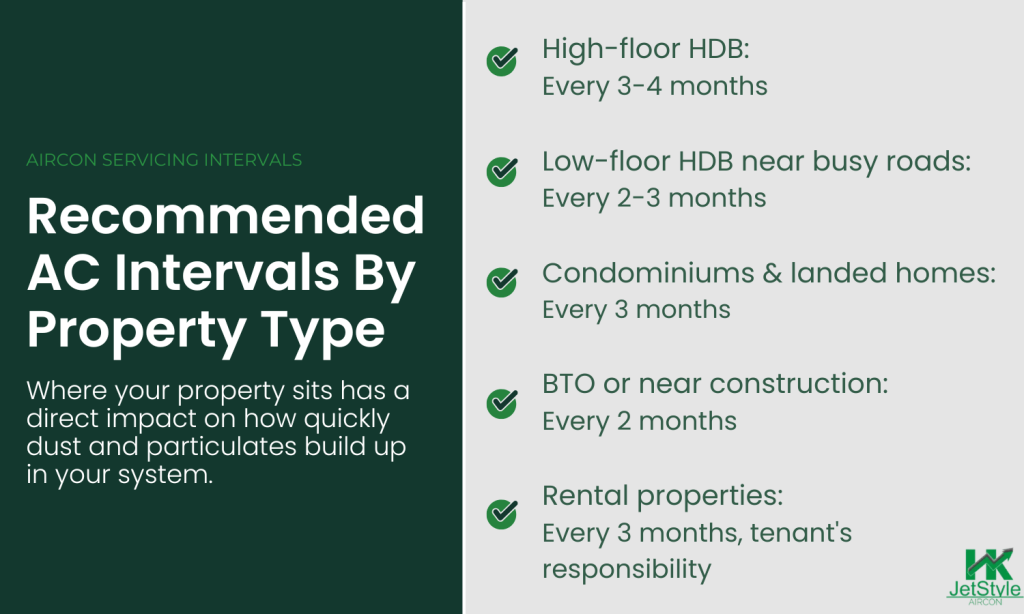
Property type also plays a big role in how often your aircon needs servicing. As an example, a high-floor HDB flat away from busy roads can typically stick to the standard 3–4-month interval without issue. At the other end of the scale, a unit in a new BTO estate or a property near active MRT construction works should default to a much tighter 2-month cycle due to the high levels of airborne dust and particulate matter in these areas.
Below is a complete breakdown of six different examples of AC service frequencies in Singapore according to property type.
Example 1: HDB Flat (high floor)
- Example Property: Standard HDB units away from main roads
- Recommended Service Interval: Every 3–4 months
Example 2: HDB Flat (low/ground floor)
- Example Property: Lower-floor HDB near busy roads or gardens
- Recommended Service Interval: Every 2–3 months
Example 3: Condominium
- Example Property: Multi-split systems across multiple rooms
- Recommended Service Interval: Every 3 months
Example 4: BTO Estate / Near Construction
- Example Property: New developments or properties near MRT works
- Recommended Service Interval: Every 2 months
Example 5: Landed Home
- Example Property: Multi-zone systems with higher cumulative runtime
- Recommended Service Interval: Every 3 months
Example 6: Rental Property
- Example Property: HDB or condo under tenancy agreement
- Recommended Service Interval: Every 3 months (tenant’s responsibility)
3 Key Factors that Impact Aircon Service Frequency in Singapore
AC Usage Frequency
This one is a no brainer. High AC use frequency means that more frequent servicing is required. Things like dust, moisture, and grime build up faster when you use your AC frequently, so it’s important to stay on top of your AC servicing.
AC System Type
The type of AC unit in your property will play a key role in determining servicing requirements. As a general rule, a simple wall-mounted split unit in an HDB bedroom is straightforward to maintain on a 3–4 service month cycle. On the other hand, a ceiling cassette in an office or a centralised system in a landed home has more components, longer runtimes, and bigger spaces to cool. All of these factors shorten the recommended servicing interval.
Property Location
Property location plays a key role in determining the ideal AC service frequency. Surprisingly, it’s the main factor that most people miss when they consider how often they should service their aircon in Singapore. As an example, an AC unit in a property away from main roadways on a higher floor is likely to stay cleaner for longer. While a property in a densely populated area on a lower level is likely to accumulate more dust and therefore require more frequent servicing.

